


WHO AM I? (11)
Who am I? (11)
Who am I? Where you are given information or clues about an actor, singer, athlete, politician, or other celebrity, and you guess who they are. Answer at the end. Were you correct?
Qui sóc? On se’t donen informacions o pistes sobre un actor, cantant, atleta, polític o una altra celebritat, i tu has d’endevinar qui és. La resposta és al final. Has encertat?
¿Quién soy? Donde se te da información o pistas sobre un actor, cantante, atleta, político u otra celebridad, y tú debes adivinar quién es. La respuesta está al final. ¿Has acertado?



SPANISH SPEAKERS (12)
English for Spanish Speakers (12)

Cognates
There are three types of cognates: perfect, true, and false, the latter perhaps better known as “false friends.”
In this third entry, we will look at false cognates. These are English and Spanish words that may share the same root and look or sound similar but have significantly different meanings—more commonly known as “false friends.” An example is simpatico, which translates to “nice” or “friendly” in English, whereas the word “sympathetic” in English means understanding or feeling sorrow for someone’s misfortune.
Cognats
Hi ha tres tipus de cognats: perfectes, veritables i falsos, aquests últims potser més coneguts com a “falsos amics.”
En aquesta tercera entrada, analitzarem els cognats falsos. Són paraules en anglès i castellà que poden tenir la mateixa arrel i semblar o sonar igual, però tenen significats molt diferents—més coneguts com a “falsos amics.” Un exemple és simpatico, que es tradueix com “agradable” o “simpàtic” en anglès, mentre que la paraula “sympathetic” en anglès significa ser comprensiu o sentir pena per la desgràcia d’algú.
Cognados
Hay tres tipos de cognados: perfectos, verdaderos y falsos, estos últimos quizá más conocidos como “falsos amigos.”
En esta tercera entrada, veremos los cognados falsos. Son palabras en inglés y español que pueden tener la misma raíz y parecer o sonar similares, pero tienen significados muy diferentes—más conocidos como “falsos amigos.” Un ejemplo es simpatico, que se traduce como “agradable” o “simpático” en inglés, mientras que la palabra “sympathetic” en inglés significa ser comprensivo o sentir pena por la desgracia de alguien.
| molestar/molestar | bother | molest | abusar /abusar |
| nús/nudo | knot | nude | nu / desnudo |
| parada / parada | stop, e.g. bus stop | parade | desfilada / desfile |
| suportar /soportar | tolerate, put up with | support | donar suport / apoyar |
| succés / suceso | event | success | èxit / éxito |
| sa / sano | healthy | sane | assenyat / cuerdo |
| estimat /estimado | esteemed | estimate | estimació / estimacion |
| èxit /éxito | success, hit | exit | sortida / salida |
LANGUAGE: USA vs UK (5)
American vs British English (5)
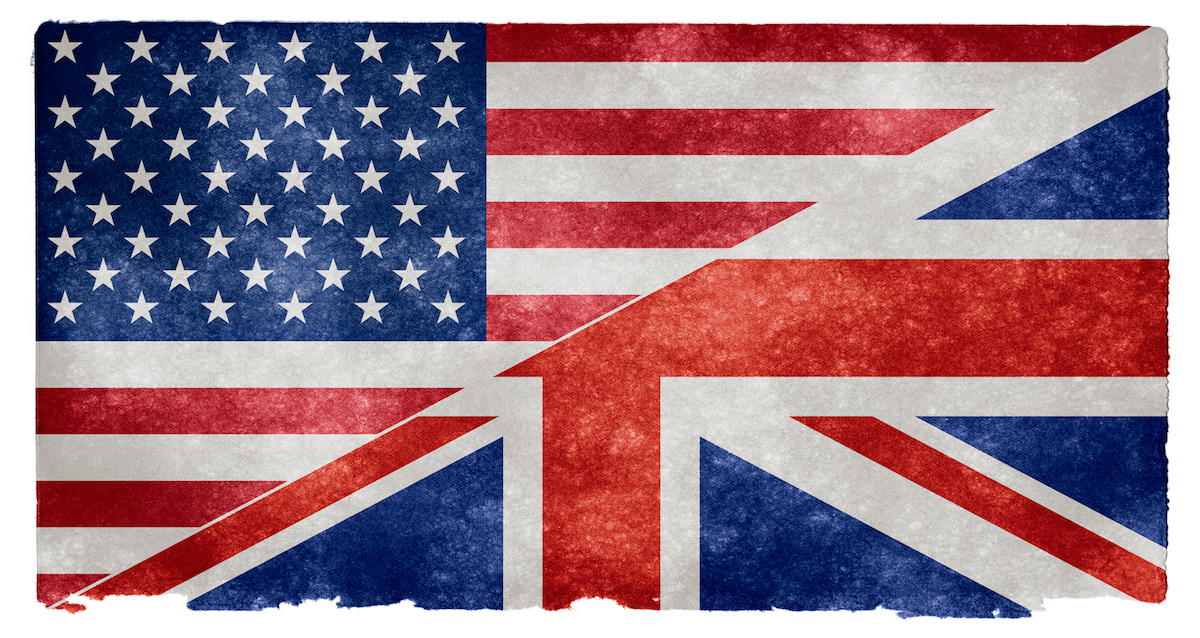
“Two nations divided by a common language.” Oscar Wilde
Not only are American and British words sometimes spelled differently (right there: spelled vs spelt), but often totally different words are used by speakers to express themselves. / No només les paraules americanes i britàniques s’escriuen de vegades de manera diferent (aquí mateix: spelled vs spelt), sinó que sovint els parlants utilitzen paraules totalment diferents per expressar-se. / No solo las palabras americanas y británicas a veces se escriben de manera diferente (aquí mismo: spelled vs spelt), sino que a menudo los hablantes utilizan palabras totalmente diferentes para expresarse.
Generally speaking, your texts will use British English, but it is a good idea to learn common American equivalent words to avoid confusion and misunderstanding. / En termes generals, els teus textos utilitzaran l’anglès britànic, però és una bona idea aprendre les paraules equivalents americanes comunes per evitar confusions i malentesos. / En términos generales, tus textos utilizarán el inglés británico, pero es una buena idea aprender las palabras equivalentes americanas comunes para evitar confusiones y malentendidos.
Here are ten American and British words that have the same meaning but, as you can see, are not similar in any way: / Aquí teniu deu paraules americanes i britàniques que tenen el mateix significat però, com podeu veure, no s’assemblen de cap manera: / Aquí tienes diez palabras americanas y británicas que tienen el mismo significado pero, como puedes ver, no se parecen de ninguna manera:
| AMERICAN | BRITISH | CATALÀ/CASTELLANO |
| candy | sweets | dolços / dulces |
| spigot | tap (outdoors) | aixeta (exterior) / grifo (exterior) |
| cab | taxi | taxi / taxi |
| semester | term | semestre / semestre |
| pantyhose | tights | mitges / medias |
| schedule | timetable | horari / horario |
| can | tin | llauna / lata |
| flashlight | torch | llanterna / linterna |
| pants | trousers | pantalons / pantalones |
| cuffs | turn-ups | baixos (pantalons) / dobladillo |
| subway | underground | metro / metro |
| vest | waistcoat | armilla / chaleco |
| closet | wardrobe | armari / armario |
| windshield | windscreen | parabrisa / parabrisas |
| zipper | zip | cremallera / cremallera |
FUN FACTS (13)
10 Fun Facts about the NBA

- Muggsy Bogues, standing 1.60m, was the shortest NBA player ever, yet he had a 14-year career. He once blocked a shot of 2.13m All-Star Patrick Ewing.
- The three-point line was first introduced by the now defunct rival ABA in 1967. First seen as a gimmick, it revolutionized the game after being adopted by the NBA in 1979.
- On March 2, 2016, the Dallas Mavericks had three players on their roster who were all born on June 26, 1984: JJ Barea, Raymond Felton, and Deron Williams.
- During the 1961–62 season, Wilt Chamberlain averaged 48.5 minutes per game, which is impossible without overtime since a regulation game lasts only 48 minutes. He also scored 100 points in a game—the NBA record—and never fouled out in 1,205 games.
- Charlotte Bobcats Hall of Shame: Kevin Berles once missed 35 consecutive shots. Adam Morrison was rumored to never shower during his time there. No wonder they changed their name to the Hornets in 2014.
- There are 79 players whose NBA career lasted just one game, including JamesOn Curry, who played only 3.9 seconds. In contrast, Vince Carter played across four decades from 1998 to 2020.
- The New York Knicks and the Boston Celtics are the only NBA teams that have never moved or changed their names.
- Early basketball rules included no dribbling, nine players per team, and peach baskets that required a ladder to retrieve the ball until a hole was cut in the bottom.
- The Los Angeles Lakers hold the longest winning streak in NBA history with 33 games, while the Cleveland Cavaliers hold the record for most consecutive losses with 26.
- The NBA All-Star Game at Dallas Cowboys Stadium set the record for the highest attendance, with 108,713 fans.
10 dades curioses sobre la NBA
- Muggsy Bogues, amb una alçada d’1,60 m, va ser el jugador més baix de la història de l’NBA, tot i així va tenir una carrera de 14 anys. Un cop va bloquejar un tir de Patrick Ewing de 2,13 m.
- La línia de tres punts va ser introduïda per la ja desapareguda ABA el 1967. Inicialment vista com una novetat, va revolucionar el joc després de ser adoptada per l’NBA el 1979.
- El 2 de març de 2016, els Dallas Mavericks tenien tres jugadors nascuts el 26 de juny de 1984: JJ Barea, Raymond Felton i Deron Williams.
- Durant la temporada 1961-62, Wilt Chamberlain va fer una mitjana de 48,5 minuts per partit, cosa impossible sense pròrrogues, ja que un partit dura 48 minuts. També va anotar 100 punts en un partit i mai va ser eliminat per faltes en 1.205 partits.
- El “saló de la vergonya” dels Charlotte Bobcats: Kevin Berles va fallar 35 tirs consecutius. Es deia que Adam Morrison no es dutxava. No és estrany que el 2014 canviessin el nom a Hornets.
- Hi ha 79 jugadors la carrera dels quals a l’NBA va durar només un partit, inclòs JamesOn Curry, que va jugar només 3,9 segons. En canvi, Vince Carter va jugar en quatre dècades (1998–2020).
- Els New York Knicks i els Boston Celtics són els únics equips de l’NBA que mai s’han traslladat ni han canviat de nom.
- Algunes regles inicials del bàsquet: no es podia botar, hi havia nou jugadors per equip i s’utilitzaven cistelles de préssecs amb escala fins que es va fer un forat a sota.
- Els Los Angeles Lakers tenen la ratxa més llarga de victòries amb 33 partits, mentre que els Cleveland Cavaliers tenen el rècord de més derrotes seguides amb 26.
- L’All-Star de l’NBA al Dallas Cowboys Stadium té el rècord d’assistència amb 108.713 espectadors.
10 datos curosos sobre la NBA
- Muggsy Bogues, con una altura de 1,60 m, fue el jugador más bajo de la historia de la NBA, y aun así tuvo una carrera de 14 años. Una vez bloqueó un tiro de Patrick Ewing de 2,13 m.
- La línea de tres puntos fue introducida por la ABA en 1967. Al principio considerada un truco, revolucionó el juego cuando la NBA la adoptó en 1979.
- El 2 de marzo de 2016, los Dallas Mavericks tenían tres jugadores nacidos el 26 de junio de 1984: JJ Barea, Raymond Felton y Deron Williams.
- Durante la temporada 1961-62, Wilt Chamberlain promedió 48,5 minutos por partido, algo imposible sin prórrogas. También anotó 100 puntos en un partido y nunca fue expulsado por faltas en 1.205 partidos.
- El “salón de la vergüenza” de los Charlotte Bobcats: Kevin Berles falló 35 tiros consecutivos. Se decía que Adam Morrison no se duchaba. No es extraño que en 2014 cambiaran su nombre a Hornets.
- Hay 79 jugadores cuya carrera en la NBA duró solo un partido, incluido JamesOn Curry, que jugó 3,9 segundos. En cambio, Vince Carter jugó en cuatro décadas (1998–2020).
- Los New York Knicks y los Boston Celtics son los únicos equipos de la NBA que nunca se han trasladado ni han cambiado de nombre.
- Algunas reglas iniciales del baloncesto: no se podía botar, había nueve jugadores por equipo y se usaban cestas de melocotones que requerían una escalera hasta que se hizo un agujero.
- Los Angeles Lakers tienen la racha de victorias más larga con 33 partidos, mientras que los Cleveland Cavaliers tienen el récord de más derrotas consecutivas con 26.
- El All-Star de la NBA en el Dallas Cowboys Stadium tiene el récord de asistencia con 108.713 espectadores.
APRIL CALENDAR 2026
Each month we will give you a list of special happenings in the UK, USA, and other English-Speaking countries, some serious, others not so much!
1: April Fool’s Day
It occurs every year on the first day of April. Also known as All Fool’s Day or Foolish Day, this is a day to play practical jokes and pranks on your friends and family. Its origins are in dispute, but written reference to the day goes back to the 14th century. One of the day’s most famous pranks was a 1957 BBC television special, showing “spaghetti trees” supposedly capable of growing fresh pasta (see below). After being bombarded by viewers wanting to know where they could buy these special trees, the broadcast company quickly had to clarify to their overly credulous viewing audience that it was indeed an April Fool’s Day hoax. Fun fact: nearly seven decades later, there is little or no evidence that BBC viewers are any less gullible. Proof? Blair, Brown, Cameron, May, Johnson, Truss, Sunak, and Starmer.
Robert Couse-Baker from Sacramento, California, CC BY 2.0, via Wikimedia Commons
.jpg)
1: National Walking Day
It is celebrated on the first Wednesday of April. So put on your most comfortable shoes and go out to celebrate! This day encourages people to be healthy and reminds them that just thirty minutes of walking every day can have a great impact on their overall health, as well as helping to prevent diseases such as cancer, diabetes, and heart disease. Fun Facts:
- The average Australian takes 9,695 steps per day (just under the optimal 10,000); the average Swiss 9,650; average Japanese 7,168; and the average American 5, 117. (Related? See obesity charts from March.)
- To burn off a single M&M candy, you would need to walk the length of a football field. One hour and 43 minutes of walking is needed to burn off a Big Mac!
- A typical pair of tennis shoes or sneakers will last for 800 kilometers of walking.
- Walking non-stop, it would take someone averaging 5.0kph, 347 days to walk the circumference of the Earth, which the average person does 3 times in their life!
- In a typical day, the total impact force on your feet can add up to hundreds of tons!

3: American Circus Day
It takes place on the anniversary of the first circus performance in America, which occurred on today’s date in Philadelphia in 1793. The modern circus had been created just decades before, by Philip Astley in England. Equestrian feats were the focus of early circuses, but in 1770, Astley added acrobats, jugglers, ropedancers, and clowns to his show to perform between the main horse-acts. In the 1840s, African elephants were introduced to the circus, and soon other exotic animals were added, and menageries became commonplace in circuses. Fun Facts:
- George Washington attended this first American circus in Philadelphia.
- The word “circus” comes from the Latin word for circle or ring.
- In Rome’s Circus Maximus, chariot races took place in front of 150,000 spectators.
- Popcorn, a popular circus snack, dates back to 400BC.
- After living in the London Zoo for 16 years, Jumbo the Elephant came to America in 1882. His popularity inspired a new word: “jumbo,” a synonym for very large.
- 19th century American circuses were often chaotic, involving gambling, excessive alcohol consumption, and fistfights, sometimes leading to full on riots. Acts included individuals with extreme deformities, the exceptionally ugly, and vomiting on command to entertain the local yokels.
Rjmail, CC0, via Wikimedia Commons

5: Easter Sunday
It is a major Christian holiday celebrating Jesus Christ’s resurrection three days after his death. As with many other Christian celebrations, it is a moveable feast, and its date always falls on the first Sunday after the ecclesiastical full moon, between March 21 and April 25. As there are almost no Fun Facts about Easter, here are a couple of jokes:
A new monk joins a monastery and takes a vow of silence. He is only allowed to speak two words to the abbot each year on Easter Sunday. On his first Easter, he appears before the abbot and says, “bread stale.” The abbot scratches his head but does not reply. The second Easter, the monk utters, “bed hard.” Again, the abbot is surprised and not sure what to think. The third Easter, the monk says, “room cold.” The fourth Easter he appears before the abbot and his two words are, “I quit!” The abbot, furious, finally responds, “I’m not surprised. You’ve been complaining non-stop since you got here.”
A young, recently engaged Catholic couple have a terrible and fatal accident while driving to church on Easter Sunday. Next thing, they find themselves standing at the Pearly Gates of Heaven in front of St. Peter. The woman asks if they could possibly get married in Heaven. St. Peter scratches his head and says, “I don’t know. No one has ever asked before. Let me find out.” Two months pass by and the couple are still waiting. During this time, they begin to wonder, if their pending marriage doesn’t work out, can they get a divorce in Heaven. After another month, St. Peter finally gets back to them, bedraggled and sleep deprived. “Yes, yes,” he informs the couple. “You can get married.” The gleeful couple responds, “Great!” And after their excitement dies down, the man sheepishly asks, “We were wondering, if things don’t work out, could we get a divorce in Heaven?” St. Peter, red-faced with anger, slams his clipboard to the ground. “Oh, come on,” he rages. “It took me three months to find a priest up here! Do you have any idea how long it will take me to find a lawyer!”
Victor Marais-Milton, Public domain, via Wikimedia Commons

11: National Pet Day
It is an unofficial holiday that takes place every year on this date and encourages people to appreciate the role that pets play in our lives. People with pets are encouraged to give them the extra appreciation that they deserve on this day. The day also brings awareness to those pets who need the most attention, the ones in shelters who are in need of a home. Fun Facts:
- Cats spend 30-50% of their waking hours grooming themselves.
- A dog’s sense of smell is up to 100,000 times more sensitive than a human’s.
- Cats don’t “meow” at other cats. They only use this sound to get attention from humans.
- Cats can jump 7 times their height. Equivalent to a 1.75m man jumping 12.25 meters—enabling him to jump and look into the third floor of an apartment! (it’s the coming down that might be even harder!)
- Similar to human’s fingerprints, a dog’s and cat’s nose print is totally unique.
- Most intelligent dogs: border collie, poodle, and golden retriever. Least intelligent: Afghan hound—requiring over 80 commands to understand a new one. Cats: Abyssinian, Siamese, and Bengal. Least intelligent: Persian, known as “furniture with fur.”
- The proper name for a group of cats is a clowder. A group of kittens is called a kindle. It’s guaranteed that 99.17% of native English speakers don’t know that! Ask!
Revisorius, CC BY-SA 4.0, via Wikimedia Commons

13: Scrabble Day
It is celebrated on this date, the birthday of its creator, Alfred Butts. Butts lost his architectural job in 1931 during the Great Depression and began brainstorming with the goal of creating a game. He wanted a word game that combined chance and skill and was influenced by crossword puzzles and anagrams. He developed his new game, which he called Lexico, which originally didn’t have a board! From1934 and 1938, he made Lexico sets by hand. He tried to license them to Milton Bradley and Parker Brothers but was rejected. It wasn’t until 1952 that the boardgame, now called Scrabble, took off, selling 37,000 sets. In 1954 it exploded, selling 4 million. As of today, 165 million sets have been sold in 31 different languages in 121 countries. Fun Facts:
- Scrabble has quite a celebrity following: regular players include(d) Daniel Radcliffe, Jon Hamm, Keanu Reeves, Sting, Drew Barrymore, Tom Cruise, Anne Hathaway, Justin Timberlake, Richard Nixon, Queen Elizabeth II, John Travolta, and Mel Gibson.
- In Britain, 53% of all homes own a Scrabble set. In the US, that number is 33%. It is rated the second-best board game in US history, just behind Monopoly.
- The seven letter vowelless words tsktsks, glycyls, and rhythms are legal in tournament play. Recent acceptable words include selfie and hashtag.
- There is a Braille version of Scrabble for blind players.
- The word “oxyphenbutazone” spelled across the top of the board, hitting three Triple Word Score squares while making seven crosswords downward would be worth 1782 points!
vastateparksstaff, CC BY 2.0, via Wikimedia Commons
.jpg)
16: National High-Five Day
It is celebrated each year on the third Thursday in April. Make sure to give a “high-five” to everyone you meet and spread the word. How did this all start? Depends on whom you ask. We’re going with the baseball story that dates back to October 2, 1977, when Los Angeles Dodgers Dusty Baker and Glenn Burke gave each other a high five in celebration. Baker’s home run had just made L.A. the first team in history to have four hitters with at least 30 home runs in a single season. Today people everywhere use it to mean “Congratulations!” or “Great job!” Fun Facts:
- A study indicated that teams that give more high-fives (and fist-bumps) have increased performance quality. In other words, it works!
- The term “high-five” entered the Oxford English Dictionary as a noun in 1980 and as a verb in 1981.
- The simple act releases dopamine, a natural happiness booster. It doesn’t matter if you are high-fiving a friend, teammate, lover, or your pet dog or cat!
- Variations have evolved over the decades and have become popular in themselves: the Baby Five, the Air Five, the Double High Five, the Fist Bump, and the Self High Five.
- A few pet shelters train their cats to high-five, as it makes them more loveable and therefore more adoptable.
- An American author wrote a book centered around high-fives, and he encourages readers to give themselves high-fives in the mirror to start their day on a more positive and joyful note, “for a happier and more productive life.”
Keith Allison, CC BY-SA 2.0, via Wikimedia Commons

17: World Hemophilia Day
It is observed to raise awareness and educate people about it and other bleeding disorders. It is a rare inherited disorder usually affecting males, where one’s blood does not clot properly causing long-lasting bleeding from injuries, which can be especially dangerous when the bleeding is internal.
Facts about the so-called “Royal Disease”:
- Queen Victoria of England (below with some of her destined casualties) carried it and passed it down to three of her children. Her son Leopold had it (dying at age 30 from a hemorrhage), and her daughter passed it to her son Friedrich, who died from a brain hemorrhage after a fall
- Victoria’s great-grandson, Tsarevich Alexei of Russia, had hemophilia, and his mother, Empress Alexandra, sought help from the healer Rasputin, whose “management” her son’s health gave him access to the Romanovs and eventually major power, which contributed to the downfall of the dynasty.
- In Spain, Queen Victoria’s great-granddaughter Victoria Eugenie also passed the condition to two of her sons, who both died young from internal bleeding after minor injuries in separate car accidents.
- Hemophilia just didn’t affect royal family members personally, but changed marriage choices and who would inherit thrones, likely changing the political landscape and thus altering the history of Europe.
Eduard Uhlenhuth, Public domain, via Wikimedia Commons
.jpg)
23: Saint George's Day
It honors Saint George, the revered patron saint of England. This day commemorates his legendary valor and the rich cultural heritage associated with his name.
- Little is known about his actual life, historical records suggest that Saint George was a high-ranking Roman soldier born around 270 AD in Cappadocia (modern-day Turkey), not England, and most likely never visited the country.
- He was executed on April 23rd, 303 AD, for refusing to renounce his Christian faith during the persecution of Christians by Emperor Diocletian.
- George is respected by both Christians and Muslims, with some Muslim scholars identifying him with the figure of al-Khadr.
- The tall tale of St. George slaying a dragon was developed centuries after his death to represent the battle between good and evil.
- He is likewise the patron saint of Catalonia (since 1456), Portugal, Moscow, Georgia, and Lebanon, as well as soldiers, scouts, and farmers.
- George’s cross did not become the official flag of England until early in the 16th century, long after he was adopted as a patron.
- The day is also celebrated in Aragon and Catalonia, each incorporating local traditions and interpretations. In Catalonia, the day is known as «La Diada de Sant Jordi,» where it is customary to exchange roses and books, which inspired the1995 origin of UNESCO World Book Day. The date also marks the date of the death of both Shakespeare (1616: Julian calendar) and Cervantes (1616: Georgian calendar) .
Sfg1966, CC0, via Wikimedia Commons

25: ANZAC Day
It is celebrated on this date in April every year in Australia and New Zealand. ANZAC stands for ‘Australian and New Zealand Army Corps’. It is a public holiday in both countries which commemorates the first significant battle fought by Australia and New Zealand during World War I, also known as the Gallipoli campaign. 2026 marks the 111th anniversary of the historic battle where over 11,000 ANZAC troops died at or around Anzac Cove (below). Facts:
- A dawn service is held at 4:28, commemorate the exact time of the original landing. Veterans and current service members, along with descendants of those who served, march through towns and cities to pay their respects.
- Poppies and rosemary are symbols of remembrance, and both are worn on this day.
- “Two-Up,” a traditional soldiers’ gambling game of WWI, otherwise illegal, is allowed to be played in pubs and clubs in Australia on this day.
- The last surviving veteran of the battle was Alec Campbell, who died in 2002 at the age of 102.
- The blame for the campaign’s disaster can be laid squarely at the feet of the British command, due to its fatal underestimation of Turkish strength, poor planning, inadequate equipment, command decisions, and, most of all, imperial arrogance spearheaded by Winston Churchill.
GrahamBould, Public domain, via Wikimedia Commons

Change the color to match your brand or vision, add your logo, choose the perfect layout, modify menu settings, add animations, add shape dividers, increase engagement with call to action and more.
28: National Superhero Day
It is for honoring both fictional superheroes and real-life superheroes—those who risk their lives to keep others safe. Both groups are role models for children, and, today, maybe even more for certain adults (see below). The day was thought up by employees of Marvel Comics in 1995. There are a countless number of fictional superheroes who are honored on the day, such as Batman, Superman, Wonder Woman, and Spiderman. But as a common phrase says, «not all heroes wear capes.» Real-life heroes put themselves in harm’s way, and in circumstances where they may risk their lives for others, just as their fictional counterparts do. Fun Facts:
- The original Superman character was supposed to be bald! His hearing is so good that he can hear all the hearts on Earth beating—seven billion of them!
- Batman is said to have an IQ of 190. (Einstein’s was 160.) He is the master of 127 different martial arts, speaks 40 languages, and though he now has a “no kill” policy, in his early appearances he cruelly killed criminals by throwing them into acid or hanging them from the Batplane.
- The Hulk was going to be grey, not green, but green ink was much cheaper to use in comic books, and it was decided it looked better on the page. So, green it was!
- Spiderman built a time machine out of a blender, microwave oven, and a VCR player; he once survived being buried alive for two weeks; he has been clocked running at 190kph.
- The creator of Wonder Woman also invented the first polygraph machine; unfortunately, the machine was rubbish and failed to work accurately in many scientific tests.
Olaf Gradin, CC BY-SA 2.0, via Wikimedia Commons

PUB QUIZ (11)
Pub Quiz (11)
A pub quiz is a contest normally held in a bar or pub. It’s a modern example of a pub game, becoming part of British culture in the 1970s, and soon afterwards introduced into Irish pubs and then spreading internationally. It involves rounds of quiz questions addressed to teams of players, touching on general knowledge (geography, science, & nature), sport, entertainment, true & false, Who am I? (see above), music, puzzles, and more. Test yourself, learn more vocabulary, and amaze your friends with your knowledge!
Un pub quiz és un concurs que normalment té lloc en un bar o pub. És un exemple modern de joc de pub, que es va convertir en part de la cultura britànica als anys 1970 i, poc després, es va introduir als pubs irlandesos i es va estendre internacionalment. Consisteix en rondes de preguntes dirigides a equips de participants, que tracten sobre coneixements generals (geografia, ciència i natura), esport, entreteniment, vertader o fals, Qui sóc? (Who am I?), música, trencaclosques i més. Posa’t a prova, aprèn més vocabulari i deixa els teus amics bocabadats amb els teus coneixements!
Un pub quiz es un concurso que normalmente se celebra en un bar o pub. Es un ejemplo moderno de juego de pub, que pasó a ser parte de la cultura británica en la década de 1970 y, poco después, se introdujo en los pubs irlandeses y se difundió internacionalmente. Consiste en rondas de preguntas dirigidas a equipos de jugadores, que abarcan conocimientos generales (geografía, ciencia y naturaleza), deporte, entretenimiento, verdadero o falso, ¿Quién soy yo? (Who am I?), música, rompecabezas y más. ¡Ponte a prueba, aprende más vocabulario y sorprende a tus amigos con tus conocimientos!
SPANISH SPEAKERS (11)
English for Spanish Speakers (11)
Frequently Misused or Confused Words / Paraules sovint mal utilitzades o confoses / Palabras frecuentemente mal usadas o confundidas
Here are some tough ones, often misused by native speakers! Aquí tens alguns casos difícils, sovint mal utilitzats pels parlants nadius! Aquí tienes algunos casos difíciles, a menudo mal usados por hablantes nativos!
Ability: ability technically refers to a learned/acquired skill
(habilitat — tècnicament es refereix a una habilitat apresa o adquirida / habilidad — técnicamente se refiere a una habilidad aprendida o adquirida)
Capacity: refers to the potential to learn or acquire a skill
(capacitat — es refereix al potencial per aprendre o adquirir una habilitat / capacidad — se refiere al potencial para aprender o adquirir una habilidad)
Bazaar: a marketplace or similar area/activity where diverse items are for sale
(basar — un mercat o lloc similar on es venen diversos articles / bazar — un mercado o lugar similar donde se venden diversos artículos)
Bizarre: weird or strange
(estrany o extravagant / extraño o raro)
Council: a body of people who make decisions
(consell — un grup de persones que prenen decisions / consejo — un grupo de personas que toman decisiones)
Counsel: to give advice, and in law, the lawyer who gives that advice
(aconsellar; en dret, l’advocat que dona aquest consell / aconsejar; en derecho, el abogado que da ese consejo)
Fewer: refers to specific numbers that are countable; “10 items or fewer”
(menys — per a coses comptables; «10 articles o menys» / menos — para cosas contables; «10 artículos o menos»)
Less: refers to unquantifiable things; “less than satisfied”
(menys — per a coses no quantificables; «menys que satisfet» / menos — para cosas no cuantificables; «menos que satisfecho»)
Imply: is to hint at something without saying it
(insinuar — donar a entendre alguna cosa sense dir-la directament / insinuar — dar a entender algo sin decirlo directamente)
Infer: to draw a conclusion from real or perceived implications
(inferir — treure una conclusió a partir d’indicis o implicacions / inferir — sacar una conclusión a partir de indicios o implicaciones)
Marital: things dealing with and related to marriage
(matrimonial — relacionat amb el matrimoni / matrimonial — relacionado con el matrimonio)
Martial: things dealing with war
(marcial — relacionat amb la guerra / marcial — relacionado con la guerra)
LANGUAGE: English Oddities (5)
English Oddities (5)
An Onomatopoeia word is one that resembles or suggests the sound that it describes. / Una onomatopeia és una paraula que s’assembla o suggereix el so que descriu. / Una onomatopeya es una palabra que se asemeja o sugiere el sonido que describe.
Animal sounds: / Sons d’animals: / Sonidos de animales:
| SOUND | CATALÀ / CASTELLÀ | ANIMAL | ANIMAL |
| Woof / Bark / Howl / Growl | bup-bup / guau-guau | dog | gos / perro |
| Meow / Purr | mèu / miau | cat | gat / gato |
| Moo | muu / muu | cow | vaca / vaca |
| Neigh | hiii / hiii | horse | cavall / caballo |
| Oink | oinc-oinc / oinc-oinc | pig | porc / cerdo |
| Baa | beee / beee | sheep | ovella / oveja |
| Cluck | coc-coc / clo-clo | chicken | gallina / gallina |
| Quack | quac-quac / cuac-cuac | duck | ànec / pato |
| Gobble | gluglú / gluglú | turkey | gall dindi / pavo |
| Hiss | sss / sss | snake | serp / serpiente |
| Roar | grrr / rugido | lion | lleó / león |
| Croak | rau-rau / croac-croac | frog | granota / rana |
| Ribbit | rau / croac | frog | granota / rana |
| Chirp / Tweet | piu-piu / pío-pío | bird | ocell / pájaro |
| Buzz | bzz / bzz | bee / fly | abella o mosca / abeja o mosca |
| Hoot | uh-uh / búho | owl | òliba / búho |
| Bray | hiii-hà / i-a | donkey | ase / burro |
| Squeak | iiii / iii | mouse | ratolí / ratón |
WHO AM I? (10)
Who am I? (10)
Who am I? Where you are given information or clues about an actor, singer, athlete, politician, or other celebrity, and you guess who they are. Answer at the end. Were you correct?
Qui sóc? On se’t donen informacions o pistes sobre un actor, cantant, atleta, polític o una altra celebritat, i tu has d’endevinar qui és. La resposta és al final. Has encertat?
¿Quién soy? Donde se te da información o pistas sobre un actor, cantante, atleta, político u otra celebridad, y tú debes adivinar quién es. La respuesta está al final. ¿Has acertado?